
Last Saturday, as I was driving to Goliad State Park about 2 hours from my home, I listened to a library audio book entitled The Gap and The Gain, by Dan Sullivan and Benjamin Hardy. Dan is a well-known business coach and Ben has a PhD in psychology.
As I listened, I began to get a better view of why some (perhaps many) Christians have a negative view of their growth. Remember when you were a new believer and would get so excited about the difference Jesus was making in your life? Where did that enthusiasm go?
Dan began coaching entrepreneurs over 50 years ago – back when coaching usually only applied to sports. He describes how one day, during a group meeting with several entrepreneurs who were making at least $200,000 annually, one of the members was particularly negative. The rest watched and listened as Dan drew a diagram on a board that would turn into the basic concept of the Gap and the Gain.
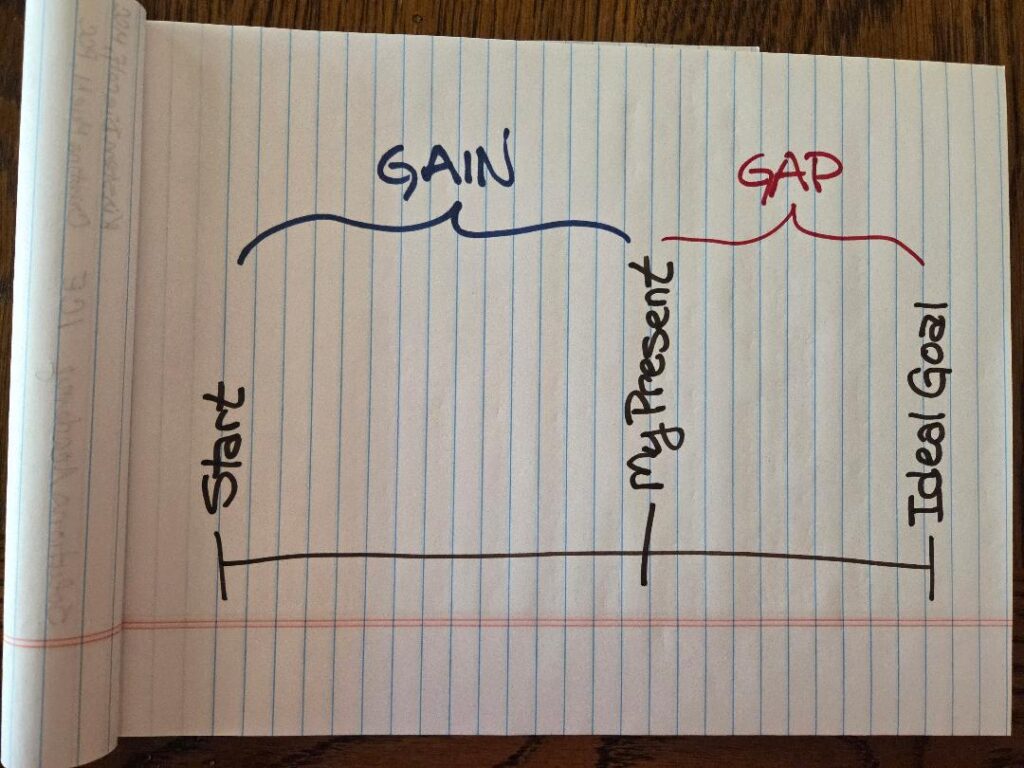
The businessman was negative because he had not reached his intended goal of a million dollars a year income. Dan wrote the word “Goal” at the top of the board. At the bottom he wrote “Start.” Then at a random place between those words, he wrote “Present.”
As Dan explained the concept, everything between “Start” and “Present” represented what this businessman had accomplished. That would include surviving the first few years of business, when over 90% experience failure during that time. This was the “Gain” that Dan was pointing out.
Rather than see the Gain, this entrepreneur was focusing on the “Gap” between the Present and his ideal Goal. Because of this Gap focus, he couldn’t see – or at least couldn’t acknowledge – all the good that had occurred since he began the business.
In the meantime, the other group members were getting excited as they focused on their individual Gains. Their excitement was turning into a new motivation to continue to grow their businesses while giving themselves credit for the growth they had already attained.
What has that got to do with Reproducing for Christ? Two things actually.
The night before my drive to the park, I had a small group of developing disciple-makers in my home for dinner. After ham and sweet potatoes – and some chocolate cake – we settled in to more than an hour’s conversation about what they were experiencing in their attempt to be and make disciples.
As I listened to the audio book, I realized that as Christians we tend to focus on the end goal rather than the growth we’ve made as believers and disciple-makers. In the moment, I was responding to their desire to reach the ultimate goal. Since I didn’t know these men very well, I had nothing to point back to for them, nor did I ask them about their previous growth.
The focus meant the conversation was more negative than positive, even though all of them left encouraged for the moment. That was exactly what Dan was pointing out in his story of the group of businessmen. One left the group with a desire to work harder; the others left the group with more motivation to carry them to the next level. That next level wasn’t their ultimate goal, but it was another step forward.
As disciple-makers, we will always experience “missing the mark.” We might say something and think, “I should have known better.” Or we might be struggling to “win a man’s heart” but feel inadequate. Each of these exacerbates the negative.
We’re much less likely to focus on the positives and how well we did in “foreign territory.” Maybe the last time we got together, we failed to ask about something important to the man in front of us. But this time we remembered to talk about that important issue with the man (which can help win his heart).
Dan Sullivan made a comment that greatly impacted me. “If we tend to focus on the Gap, we will also see the Gap in others.” It’s one thing to “hold ourselves accountable” to growing in our walks with Christ. It’s different to never be satisfied with where we are in our journey. And then to project that same negativity on to the men we are discipling.
After listening to this audio book, I made the decision to become more mindful of my own Gap thinking and shift to Gain thinking when I recognize it. I want to do that when thinking about myself and during the time that I spend with the men I disciple and equip.
How about you? How much of your thinking, either in your Christian walk or for life in general, is spent on the Gap? How might it become different if you focus on your Gain?